

What Are Pulling Irons and Why Are They Required in Concrete Manholes?
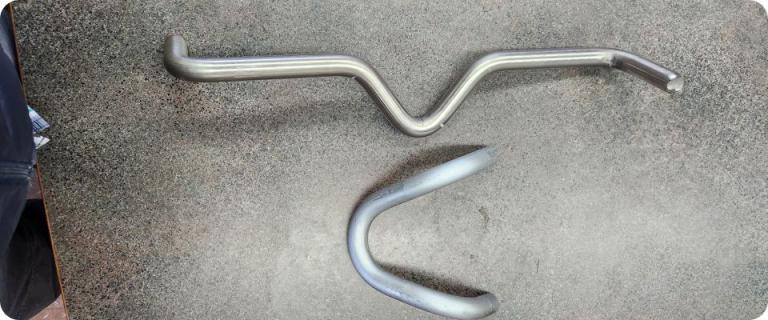
If you've ever tried to pull cable through a duct with nothing solid to rig against, you already know why pulling irons exist. A pulling iron is a heavy steel loop or U-shaped bar cast into the wall or floor of a concrete manhole or utility vault, providing your crew with a fixed anchor point to pull against. When a winch or block and tackle puts thousands of pounds of tension on a conductor, that force has to load onto something that will not budge. The pulling iron is what the rigging hooks to.
Here's the catch: You cannot add a proper anchor once the concrete has cured. A manhole wall is smooth and reinforced, with no built-in point strong enough to take a full-tension pull. The anchor has to be set while the structure is still being formed, so precast manufacturers and utilities call out pulling irons as part of the pour rather than leaving it for the field crew to sort out later.
Why Cable Pulling Needs a Fixed Anchor
Underground runs between manholes commonly reach 100 to 150 feet, and long or curved runs build friction fast. Pulling large conductors or innerduct through that distance can take several thousand pounds of force. This isn't the place to improvise. Federal and utility specifications put hard numbers on it. The Unified Facilities Guide Specifications tell crews to install a pulling-in iron in the wall opposite each duct line entrance, and many utility standards rate that iron for 10,000 pounds of pulling tension.
Position Matters as Much as Strength
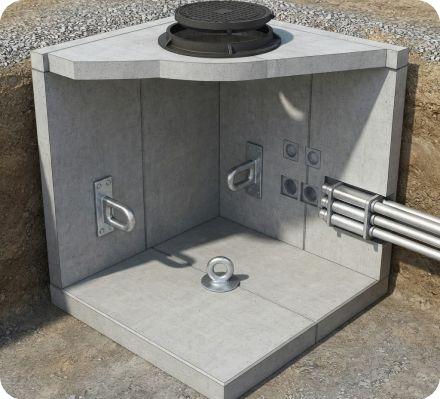
The iron sits on the wall directly across from the duct, so the pulling line runs straight into the conduit mouth. That straight shot keeps the sheave or quadrant block in line and level with the duct, protecting the cable from sharp bends and maintaining consistent tension throughout the pull.
When an iron is missing or doesn't line up, crews end up fighting the job with temporary rigging, such as a jamb skid braced against the opening. It works in a pinch, but it eats setup time and rarely holds up like a cast-in anchor on a heavy pull.
Where Pulling Irons Go in a Manhole
Utility drawings are specific about placement for good reason.
A typical precast power or telecom manhole detail calls for one pulling iron in each wall opposite every present and future duct run, plus one in the floor centered under the cover opening. The wall irons handle the horizontal pulls through the duct bank. The floor iron gives your crew an anchor for lowering and raising heavy cable, splice cases, and gear through the roof opening.
It's important to carefully consider future duct runs. When a wall has knockouts for ducts that haven't been installed yet, the drawing still needs an iron opposite those spots so the structure is ready when the run finally gets built. Skip it, and someone is breaking concrete down the road, which is slow work that's hard on the manhole.
Material and Traceability Requirements
A pulling iron lives in a wet, corrosive spot for the entire life of the manhole, so material choice is a real part of the spec. Hot-dip galvanized steel is the workhorse, coated to ASTM A123 for long-term corrosion resistance. At Valley Nut & Bolt, our pulling irons are cold-bent and stress-relieved before galvanizing, so the finished part holds its rated strength. Where conditions are harsher or where an owner would rather avoid fighting coating wear over decades of service, stainless steel is the better choice.
Traceability matters just as much as the metal. Every part we make ties back to batch numbers and quality control data, exactly what public agencies want as proof of what went into the ground. That's why our pulling irons are American-made and QPL-certified by the Washington State DOT. On DOT and municipal jobs, that documentation is often what closes out the submittal. Get the anchor right at the manufacturing stage, and you keep your crew safe and your cable pull on schedule years down the line.
Is a pulling iron the same as a pulling eye or a pull iron?
They refer to the same class of part. Specifications and shop drawings use pulling iron, pulling-in iron, pull iron, and pulling eye more or less interchangeably for a steel anchor cast into concrete for rigging. Shapes vary, from a closed loop to a U or a V with offset legs, but the job is the same. When you read a spec, match the load rating and dimensions, not the name.
Can a pulling iron be added to a manhole that is already poured?
Not as a true cast-in anchor. The holding strength comes from the legs being embedded before the concrete sets. For existing structures, options are limited to pocketed or bolt-in inserts, rated well below those of a cast-in iron, or temporary rigging braced against the opening. This is why the pulling iron layout belongs on the precast drawing, before the pour.
What size pulling iron do I need?
Size follows the pull tension and the duct layout on your drawing. Our pulling irons run in diameters from three-quarters of an inch to seven-eighths of an inch, in a range of lengths to suit the wall thickness and embedment called for. If the spec gives a tension rating instead of a dimension, send it over, and our team can match a part to it.
Get the Right Pulling Irons for Your Project
Valley Nut & Bolt has supplied the Pacific Northwest with fasteners and custom hardware since 1969, and we make our pulling irons right here in the USA. If you're spec'ing a precast structure or placing a custom order, our team can help you size and finish pulling irons to match your drawing and the standard your project answers to. Call us at 360-763-4030 or request a quote, and let us get you what you need.
Conclusion
Pulling irons might be a small part of a manhole's overall design, but skipping or misplacing them creates problems no crew wants to deal with mid-pull. Get the size, placement, and material right at the drawing stage, and every cable pull on that structure goes smoother for decades to come.
Relevant Reading
This is an example of large format copy. The width of this block has a max-width of 800px for increased readability. This is an example of large format copy. The width of this block has a max-width of 800px for increased readability.